Why are fractions so difficult to understand?
I often get asked why fractions are so challenging to learn. In casual conversations with adults when I ask them what concept seemed to take them out of the math game the most widely shared response is “Fractions.” It is the “F-word” of elementary mathematics for a reason.
Why do fractions cause so much frustration? One main reason is that the meaning of a fraction can change depending on the situation.
Consider these two problems. Take a moment to solve each of these problems.
Problem 1: Fractions as Measurement
Yesterday, you walked 3/4 of a mile. Today, you walked 5/8 of a mile. How far did you walk altogether?
Problem 2: Fractions as Ratio
A quiz contains two essay questions. Your teacher records your score on the first essay as 3/4 and your score on the second essay as 5/8. What is your overall score on the quiz?
Both problems use the same two fractions: 3/4 and 5/8. However, they produce different answers. What? I bet you did not see that coming! Here is why.
In the walking problem, you walked 1 3/8 or 11/8 miles.
In the quiz problem, you earned 3 points out of 4 on the first question and 5 points out of 8 on the second. Altogether, you earned 8 points out of 12. Your overall score was about 67%.
How can the same two fractions produce two different answers?
The answer is that the fractions play different roles in the two situations.
Fractions Can Have Different Meanings
A fraction does not always mean exactly the same thing. Depending on the situation, a fraction can represent:
A number or measurement, such as ¾ of a mile
An action, such as finding ¾ of 24 cookies
Division, such as determining the decimal equivalent of 3/4.
A ratio, such as earning 3 points out of 4 possible points
This is one of the major differences between fractions and whole numbers. When students see the whole number 4, its meaning is usually fairly stable—it is 4 of some unit. When they see 3/4, they must use the context to decide what that fraction represents and how to work with it. For example, in our situation does it represent a number? Or, does it represent a ratio? The answer to this question dictates how we interpret the fraction.
Fraction as a Number: The Denominator Names the Unit
Fractions introduce students to an important new idea: the denominator names the size of the fractional unit.
For example: 3/4 means 3 fourths or 3 x (1/4)
The denominator, 4, meaning fourths, cues us to divide the whole (whatever it is) into four equal parts. Each part is one fourth. The numerator, 3, tells us how many of those parts we have.
A helpful way to say this is:
The denominator names the unit, and the numerator counts the units.
In 3/4 the unit is one fourth (1/4), and we have three of those units. In 5/8, the unit is one eighth (1/8), and we have five of them.
This can be confusing because students are accustomed to numerals telling them how many. In whole numbers, for example:
400 means 4 hundreds.
4,000 means 4 thousands.
Even with the fraction 4/5 the 4 in the numerator is a count of the unit of fifths. The role of the numeral changes when it is the denominator of the fraction. With fractions, the 4 in the denominator of 3/4 does not mean that we have four of something. Instead, it tells us the size (i.e., fourths)—and the name—of the unit being counted.
Understanding this shift is essential for making sense of fractions.
Why We Need Common Denominators
Let’s return to the walking problem.
We want to combine 3/4 of a mile and 5/8 of a mile. At first, we have two different sizes of units: fourths and eighths.
Adding them immediately would be like trying to add 3 feet and 5 inches and calling the answer “8 feet-inches.” Before combining the amounts, we need to express them using the same unit.
Because one fourth is equal to two eighths, three fourths is equal to six eighths (I will discuss Equal Exchanges in a future blog post. If you want to learn more about them check out the resources page.) I will give you a little teaser later in the blog post.
Now both measurements are expressed in the same size of unit, eighths, so we can add them together. This is illustrated in the figure below.
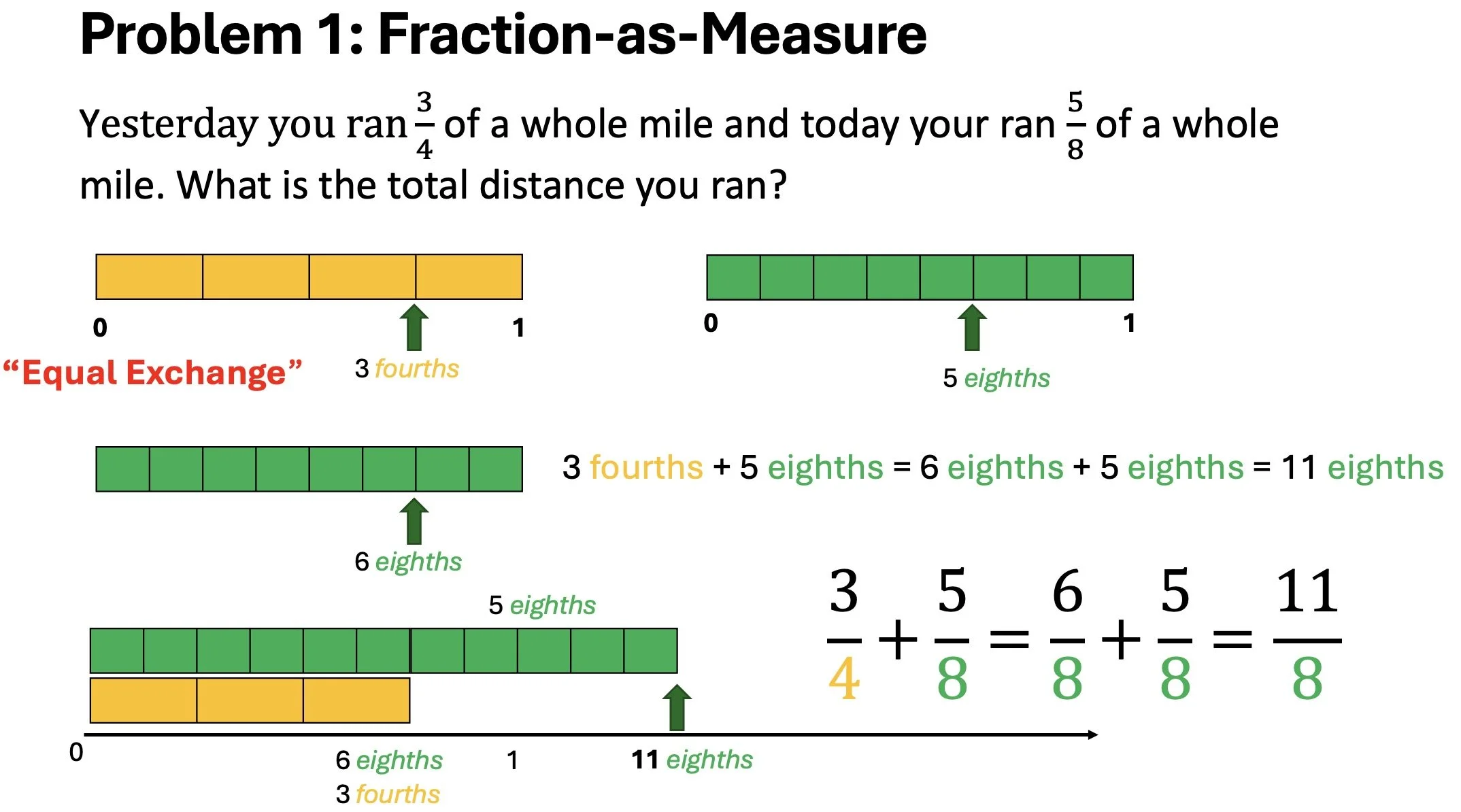
Combining lengths of 3/4 and 5/8 of a whole unit yields 11/8 of a whole unit or 1 whole unit and 3/8 of another whole unit.
Finding a common denominator is not merely a rule students must memorize. It is a way of renaming fractions so that they use the same-sized unit.
We do something similar when we change 3 feet into 36 inches before combining it with another measurement in inches. The amount has not changed; only the unit used to describe it has changed.
Why the Quiz Problem Is Different
In the quiz problem, 3/4 and 5/8 describe scores rather than distances.
The first score means:
3 points earned
4 points possible
The second score means:
5 points earned
8 points possible
To find the overall score, we combine the points earned and the points possible. This is shown in the figure below.
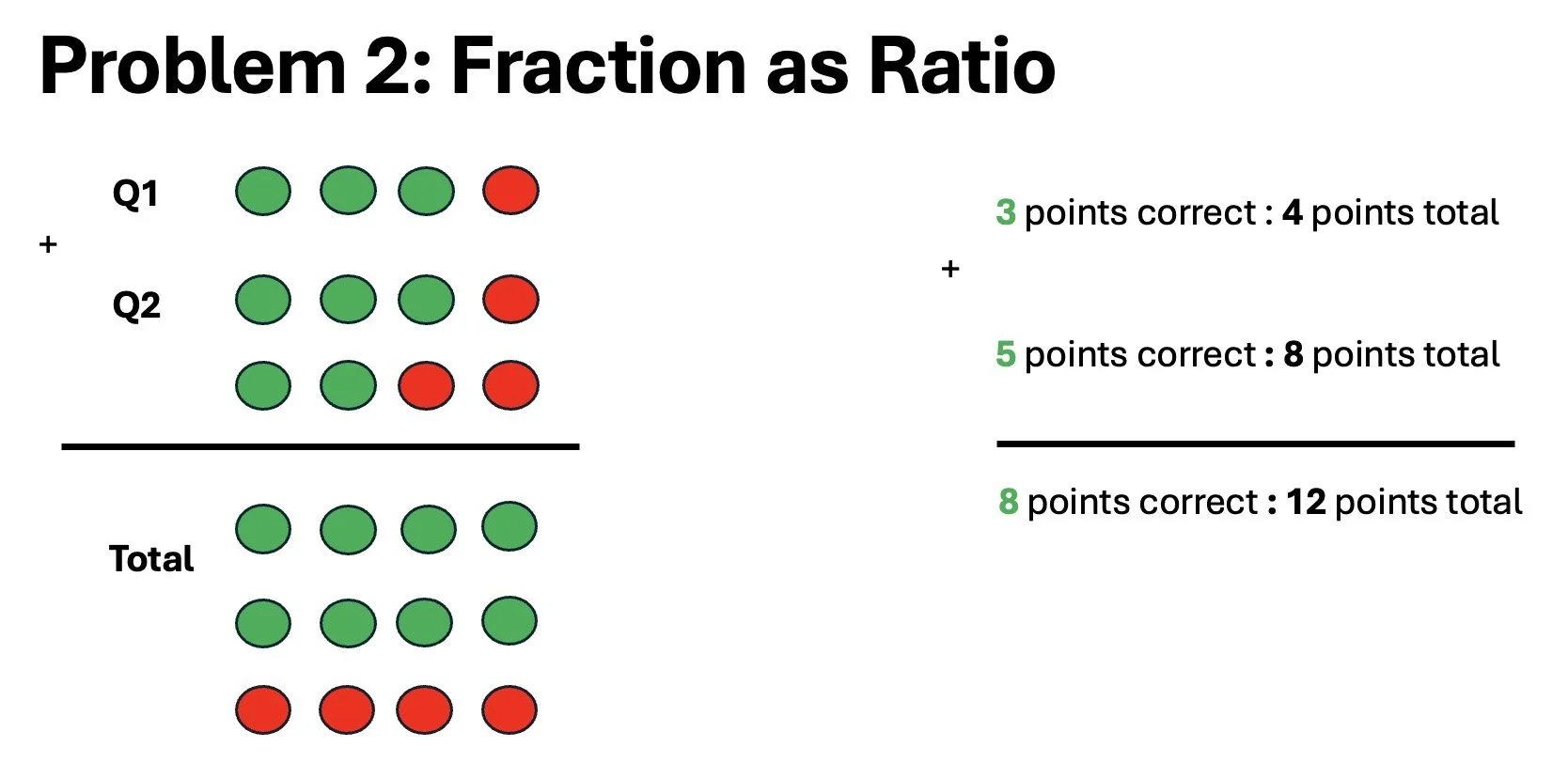
Showing that a 3 “out of” 4 and a 5 “out of” 8 yields an 8 “out of” 12 on the quiz.
Here, we are NOT adding three fourth-sized pieces to five eighth-sized pieces. Instead, we are combining two pairs of quantities: points earned and points possible.
That makes this a ratio interpretation of fractions.
This distinction also explains why teachers should be careful with the phrase “out of.” That language works well for a score such as “3 points out of 4 possible points.” However, it can be misleading when a fraction represents a measurement. Saying “three out of four” does not emphasize that 3/4 is a number made from three units of one fourth.
Three Reasons Fractions Are Difficult
Fractions are challenging for at least three important reasons.
First, fractions can have different meanings in different situations. Students must decide whether a fraction represents a measurement, an action, division, or a ratio. The third grade standards in Missouri and other states emphasize the important of developing a measurement conception first. One of my biggest recommendations to do this is to utilize the word-label to represent the size of the unit (3 fourths instead of 3/4) when students first experience fractions. Focus their attention on the meaning of the unit. We do the same with whole numbers. For example, 300 is 3 hundreds. Doing illuminates the size of the unit. I also strongly recommend utilizing a bar-number line model as I did in first figure so that students can see the relationship between the numbers. If you want to know more check out Chapter 3 Fractions: The F Word of Elementary Mathematics in my book See it, Say it, Symbolize it.
Second, related to the first point, students must understand in measurement situations that the denominator names the size of the unit while the numerator tells how many of those units are present. This is the connection to whole numbers.
Third, a fraction can be renamed using a different-sized unit without changing its value:
3 fourths = 6 eighths or 3/4 = 6/8
This idea—the same fractional length represented with different quantities and sizes of units—is powerful, but it is not obvious to many students. The idea of equal exchanges is a superpower understanding that will transform the way children see often disconnected mathematical ideas. It is what we do with money (e.g., 1 ten-dollar bill = 2 five-dollar bills), composing and decomposing whole numbers (e.g., 1 ten = 10 ones) and also with fractions (e.g., 3 fourths = 6 eighths). An example of this is shown in the figure below.
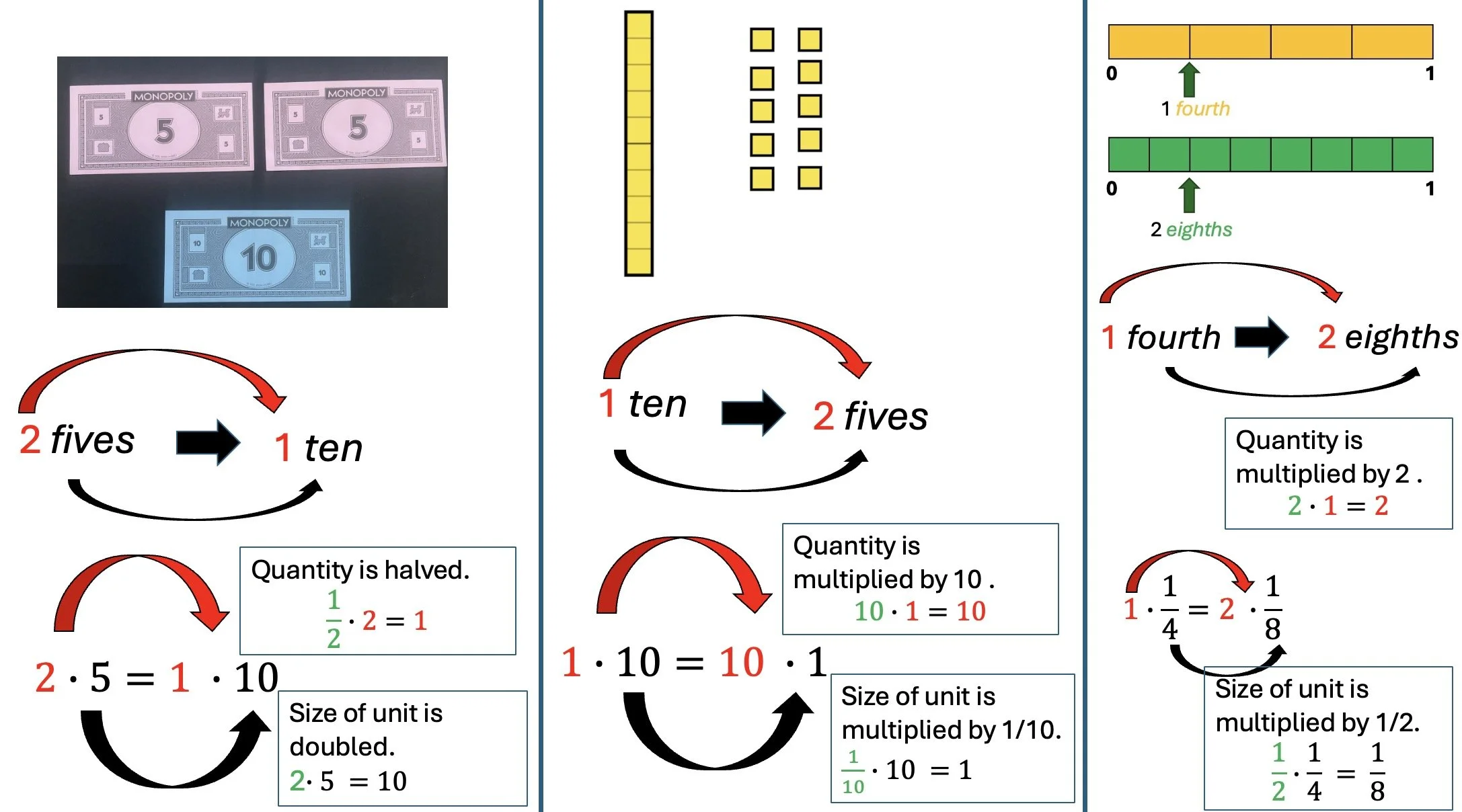
The concept of Equal Exchanges across mathematical ideas
If we want students to understand fractions, we cannot begin and end with procedures such as “find a common denominator” or “multiply the numerator and denominator by the same number.” Students also need to understand what the fractions represent, what units are being counted, and why those units sometimes need to be renamed.
Fractions are difficult, but they are not mysterious. When students learn to identify the meaning of a fraction, name its unit, and reason about equivalent units, fractions begin to make much more sense.
Want to explore these ideas with your teachers?
Looking for professional learning that helps teachers unleash your students’ fraction brilliance? Explore Professional Learning
You can also explore additional mathematics teaching resources.