Just Say No…to “Keep, Change, Flip”
I am a product of 1980s schooling.
If you grew up around the same time, you probably remember the famous anti-drug public service announcement. A stern-looking man holds up an egg and announces:
“This is your brain.”
Then he cracks it into a sizzling frying pan.
“This is your brain on drugs.”
And after allowing us to contemplate the unfortunate fate of the egg, he looks back into the camera and asks:
“Any questions?”
Then there was the other message seemingly everywhere during the decade—courtesy of Nancy Reagan:
“Just Say No!”
I didn't particularly like eggs, and I wasn't interested in drugs, so I'm not sure either campaign deserves much credit for keeping me on the straight and narrow. I had already said no to both.
But I understood the message.
Some choices can have consequences that aren't immediately obvious.
After more than thirty years of teaching mathematics, I find myself asking a similar question about my own profession:
Are there things we do in mathematics classrooms that help students get an answer today but actually make it harder for them to think mathematically tomorrow?
I think there are.
And there is one practice in particular that I think deserves its own “Just Say No” campaign:
Teaching mathematics through tricks.
One of the most common examples?
Keep. Change. Flip.
Okay, before you close the browser or start composing an angry email to the math professor, give me a chance to make my case.
The Problem Isn't That It Works
Let's start with something important:
Keep, Change, Flip works.
If students are asked to calculate
3⁄4 ÷ 1⁄3
they can keep the first fraction, change division to multiplication, flip the second fraction, and get the correct answer.
That's exactly why the shortcut is so appealing.
It's quick.
It's easy to remember.
It produces correct answers.
And I have taught shortcuts like this myself.
The problem isn't that Keep, Change, Flip doesn't work.
The problem is what students may never learn because it works so well.
I see the consequences regularly.
I teach mathematics content courses for future elementary, middle school, and secondary teachers. I also teach our university's lowest-level college mathematics course. Nearly all of those students have successfully completed Algebra II or a higher mathematics course in high school.
I've also conducted research with students in grades 4 through 7 examining their understanding of fractions.
Across all of those settings, I have asked questions such as:
What does 3⁄/4 ÷ 1⁄3 actually mean?
Or:
A cookie recipe calls for 3 /4 of a cup of sugar. You have 6 cups of sugar. How many batches of cookies—including partial batches—could you make?
These questions can make otherwise successful mathematics students surprisingly uncomfortable.
Some immediately reach for a calculator.
Some stare at the numbers.
And eventually someone will ask:
“Is this where I use Keep, Change, Flip?”
That question fascinates me.
The student remembers what to do.
But the student may have no idea what the mathematics means.
And those are not the same thing.
An Interesting Difference I've Noticed
Over the years, I've also had the opportunity to teach students educated in South Korea, Taiwan, China, Oman, Germany, Greece, and several other countries.
One thing has always intrigued me.
Many of those students have never heard the phrase “Keep, Change, Flip.”
By contrast, many of my U.S.-educated students know the phrase immediately.
But when I ask:
Why can we flip the second fraction?
or
What does dividing by1/3 actually mean?
the room often becomes much quieter.
That should make us curious.
Our assessment-driven system understandably values students getting correct answers. And Keep, Change, Flip is extraordinarily efficient at producing correct answers on pages filled with fraction-division exercises.
But getting answers cannot be the finish line.
Our goal should be to help students become thinkers, not simply answer-getters.
A shortcut can be useful once students understand the mathematics.
But when the shortcut replaces the mathematics, students can become dependent upon it.
They begin to experience mathematics as a collection of mysterious commands:
When you see this, do that.
Move this over there.
Cross these out.
Flip that.
Don't worry about why.
That isn't the mathematical experience I want for students.
So What Should We Do Instead?
If we are going to say no to Keep, Change, Flip as the starting point for fraction division, we have to replace it with something better.
For me, that means helping students develop three things:
A way to see division.
Language for talking about division.
An algorithm that connects to mathematics they already understand.
One resource that has greatly influenced my thinking is Sue Empson and Linda Levi's Extending Children's Mathematics: Fractions and Decimals.
Let's look at what an alternative approach might actually look like.
First, Let Students See the Division
Consider this problem:
Gwen has 6 yards of ribbon to make bows. Each bow requires ¾ of a yard of ribbon. How many bows can Gwen make before she runs out of ribbon?
Before thinking about an algorithm, stop and picture the situation.
You have 6 yards of ribbon.
Each bow uses 3/4 of a yard.
The question is really:
How many groups of 3/4 are contained in 6?
Imagine representing the six yards.
Each yard could be partitioned into fourths.
That gives us:
6 = 24⁄4
Now instead of asking how many groups of 3/4 are contained in 6, we can ask:
How many groups of 3 fourths can be made from 24 fourths?
That is a question students can see.
Twenty-four fourths grouped three at a time produces eight groups.
So:
6 ÷ 3⁄4 = 8
The answer 8 isn't merely the result of manipulating symbols.
It means something.
Eight groups of 3/4 yard fit into 6 yards.
That is mathematics students can reason about.
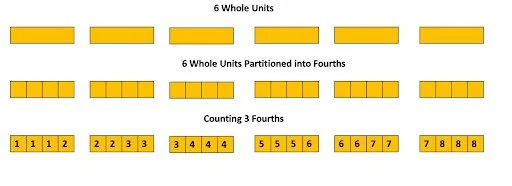
Modeling how many groups of ¾ are in 6 whole.
Then Give Students Language
The language we use matters enormously.
For the expression
6 ÷ 3⁄4,
I want students to be able to say:
“How many groups of three-fourths are contained in six?”
That simple sentence gives students a tool they can use long after they have forgotten a mnemonic.
Consider:
4 1⁄2 ÷ 1⁄4.
Instead of reaching automatically for an algorithm, a student can ask:
“How many one-fourths are in four and one-half?”
Now mental reasoning becomes possible.
There are four fourths in every whole.
Four wholes contain sixteen fourths, and another half contains two more.
So there are 18 fourths.
Or consider:
6 ÷ 0.01.
The same language tells us:
“How many hundredths are contained in six?”
If we think about money:
How many pennies are in six dollars?
Six hundred.
No Keep, Change, Flip required.
The language gives students access to the mathematics.
It also helps them estimate.
Consider:
1⁄4 ÷ 1⁄3.
Before calculating anything, a student can reason:
“How many groups of one-third fit inside one-fourth?”
Since 1/4 is smaller than 1/3, we know immediately that the answer must be less than one.
That kind of reasoning is nearly impossible when students' only question is:
“Which number do I flip?”
What About an Algorithm?
Students absolutely should learn efficient algorithms.
Understanding mathematics does not mean abandoning efficiency.
But I would argue that the algorithm should grow out of ideas students already understand.
One possibility is sometimes called the common-denominator algorithm.
Return to:
6 ÷ 3⁄4.
Because
6 = 24⁄4,
we can write:
24⁄4 ÷ 3⁄4.
Now the units are the same.
The question becomes:
How many groups of 3 fourths can be made from 24 fourths?
Which is equivalent to:
24 ÷ 3 = 8.
Students can see how fraction division connects directly to whole-number division.
Now consider the problem that causes so many of my students trouble:
3⁄4 ÷ 1⁄3.
The question is:
How many groups of one-third are contained in three-fourths?
The problem is that the units are different—thirds and fourths.
So let's rename both fractions using the same-sized pieces:
3⁄4 = 9⁄12
and
1⁄3 = 4⁄12.
Now the question becomes:
How many groups of 4 twelfths can be made from 9 twelfths?
Or:
9 ÷ 4 = 9/4 = 2 1/4.
Suddenly the answer has meaning.
There are two and one-fourth groups of one-third in three-fourths.
And notice what we did not have to tell students:
“Just flip it.”
We gave them mathematics they could reason about.
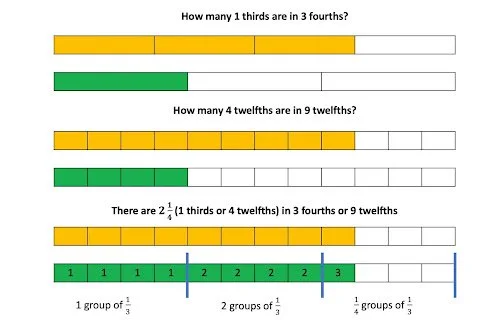
Modeling how many groups of 1/3 are in 3/4.
Shortcuts Should Follow Understanding
This is really the heart of my concern.
I am not opposed to shortcuts.
Mathematics is filled with shortcuts. In fact, mathematical notation itself is a wonderfully efficient shortcut.
And there may be contexts later in students' mathematical development—such as manipulating complicated rational expressions—where multiplying by a reciprocal is exactly the efficient move we want them to make.
But there is an enormous difference between a shortcut students use because they understand the mathematics and a shortcut students use instead of understanding the mathematics.
I recently asked a class of approximately fifty college students:
“Why does Keep, Change, Flip work?”
Not one student could explain why dividing by a number is equivalent to multiplying by its reciprocal or connect the procedure to the meaning of division.
But almost every student knew the rule.
Think about that.
They had retained the trick.
They had lost the mathematics.
A colleague once described the concern to me this way:
“When we give students Keep, Change, Flip before they understand fraction division, we may unintentionally communicate that there is nothing else left to think about.”
I think that's exactly right.
And it leads to a principle I try to remember in my own teaching:
A shortcut that follows understanding can create efficiency.
A shortcut that replaces understanding creates dependency.
Maybe It's Time to “Just Say No”
So yes, I am a child of the 1980s.
And apparently those public service announcements stuck with me more than I realized.
I am not quite ready to crack an egg into a frying pan while shouting:
“This is your brain on Keep, Change, Flip!”
Although I admit the visual would probably get some attention at a professional-development workshop.
But I am ready to ask us to reconsider what we are giving up when we teach tricks before understanding.
There is so much more we want children to know about division than how to produce an answer.
We want them to be able to see the mathematics.
We want them to be able to say what the mathematics means.
And then we want the symbols and procedures they use to represent ideas they actually understand.
So perhaps the message isn't simply:
“Just Say No to Keep, Change, Flip.”
Maybe the better message is:
Say yes to understanding first.
Because our students deserve more than a trick for getting the right answer.
They deserve mathematics that makes sense.
Want to explore these ideas with your teachers?
Patrick offers interactive K–8 professional learning focused on sense-making, fractions, multiplicative reasoning, and mathematical language.
Explore Professional Learning