Old Math vs. New Math: What’s the Difference? | Dr. Patrick Sullivan
In the middle of my class this morning, a student asked a great—and very fair—question:
“What is the difference between ‘old math’ and ‘new math’?”
Instead of answering directly, I wrote a problem on the board:
29 + 38
These are adult learners. They have years and years of experience doing mathematics, so I asked them simply to solve the problem and share how they thought about it.
The first strategy I heard was:
“Twenty and thirty is fifty. Nine and eight is seventeen. Fifty and seventeen is sixty-seven.”
Then came the familiar strategy:
“Nine and eight is seventeen. Write the seven, carry the one. One, two, and three is six. So sixty-seven.”
And then a third student said:
“I took one from thirty-eight and gave it to twenty-nine. That makes thirty plus thirty-seven, which is sixty-seven.”
There was an audible gasp across the room.
So I stopped.
“Why the gasp?”
Several students responded with almost exactly the same words:
“I didn’t know you could do that!”
And that might be one of the best explanations of the difference between what people often call “old math” and “new math.”
For many of us, our experience with math was primarily about learning the way to solve a problem. We were shown a procedure, practiced that procedure repeatedly, and became proficient at carrying it out. Maybe we eventually understood why it worked. Maybe we didn’t.
And to be clear, there is nothing wrong with knowing an efficient procedure. The standard addition algorithm represented in the second strategy is powerful, efficient mathematics. I want students to know it.
But I don’t want that procedure to be the boundary of what they believe they are allowed to do mathematically.
What people often call “new math” is really an effort to help students make sense of mathematics—not simply perform it.
Look again at the three strategies.
The first student decomposed the numbers by place value:
29 + 38 = 20 + 30 + 9 + 8 (Strategy 1)
The second used the standard algorithm. (Strategy 2)
The third student used compensation. They recognized that moving one from 38 to 29 does not change the total:
29 + 38 = 30 + 37 (Strategy 3)
Same problem.
Same answer.
Three different ways of thinking.
The goal isn’t to make children learn twelve different ways to add just for the sake of learning twelve different ways.
The goal is to help them understand numbers well enough that they can choose a strategy that makes sense.
That is harder to teach.
Giving children the platform to share their reasoning strategies is messier than just having them follow a set of steps. Children may think about a problem differently than we do. Their work may not fit neatly into a single algorithm. Teachers have to listen to their reasoning, make sense of it, and help connect one idea to another.
But there is something incredibly important gained in that messiness.
Students begin to see mathematics as something they can reason about, not simply something they have to remember.
And perhaps most importantly, we want fewer adults sitting in a mathematics classroom someday, watching someone turn 29 + 38 into 30 + 37, and gasping:
“I didn’t know you could do that!”
Because they should know.
They should know that mathematics is not a collection of rules handed down to us that we must obediently follow.
It is a connected system of ideas that we can understand, reason about, and use flexibly.
Maybe that is what “new math” is really trying to accomplish.
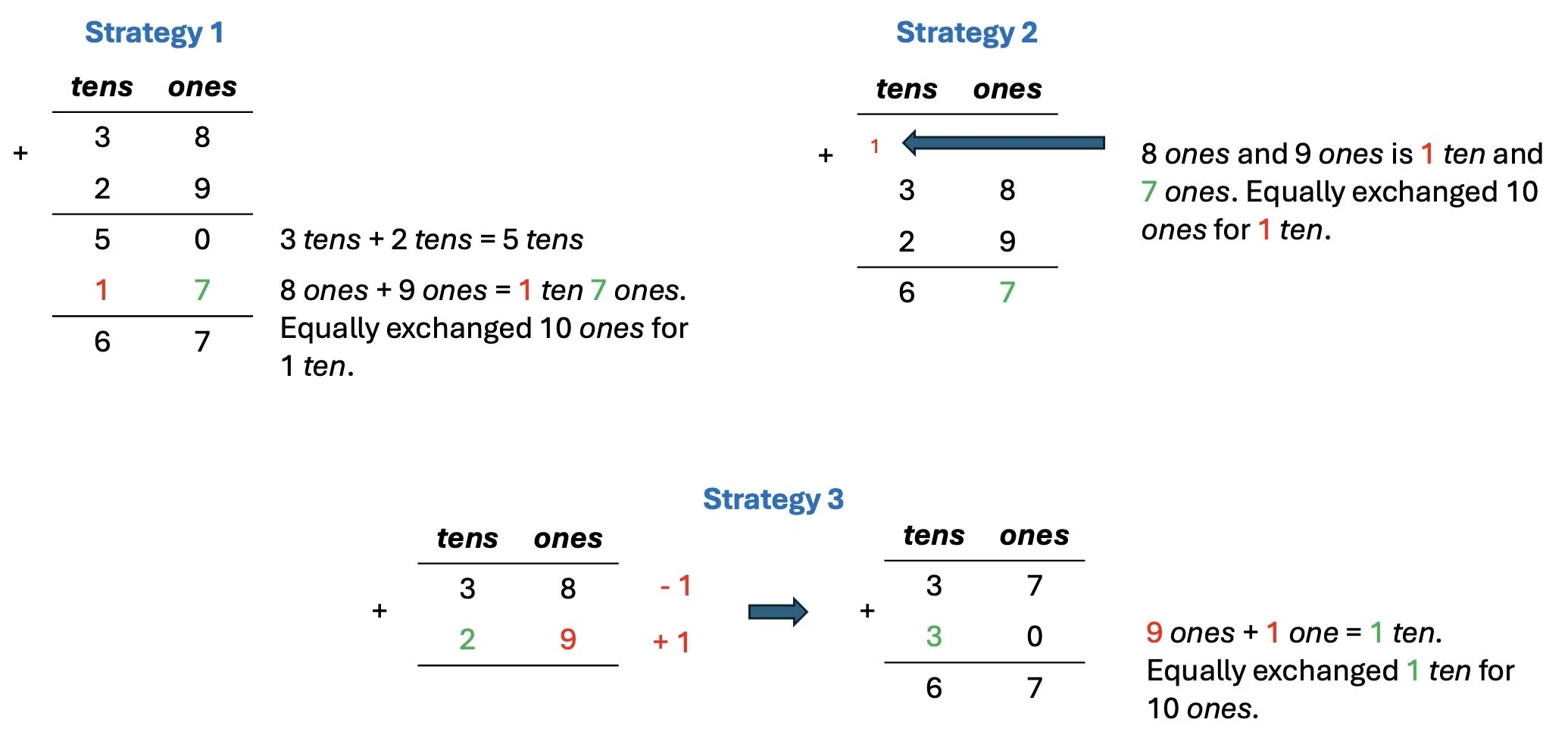
The three strategies shared by students recorded symbolically with the “why” behind the actions shared.
Want to explore these ideas with your teachers?
Patrick offers interactive K–8 professional learning focused on sense-making, fractions, multiplicative reasoning, and mathematical language.
Explore Professional Learning