Equal Exchanges: A Mathematical Superpower
Beginning with a Familiar Exchange
Most of us have exchanged money without thinking much about the mathematics involved. Imagine exchanging one ten-dollar bill for bills or coins of another denomination. You could receive two five-dollar bills, ten one-dollar bills, one hundred dimes, or one thousand pennies. The number of objects changes, and the value of each object changes, but the total value remains ten dollars. This familiar transaction illustrates a powerful mathematical idea: an equal exchange.
What Makes the Exchange Equal
Consider the exchange of one ten-dollar bill for two five-dollar bills. The number of bills doubles, from 1 to 2, while the value of each bill is cut in half, from ten dollars to five dollars. These two changes balance one another, so the total value stays the same.
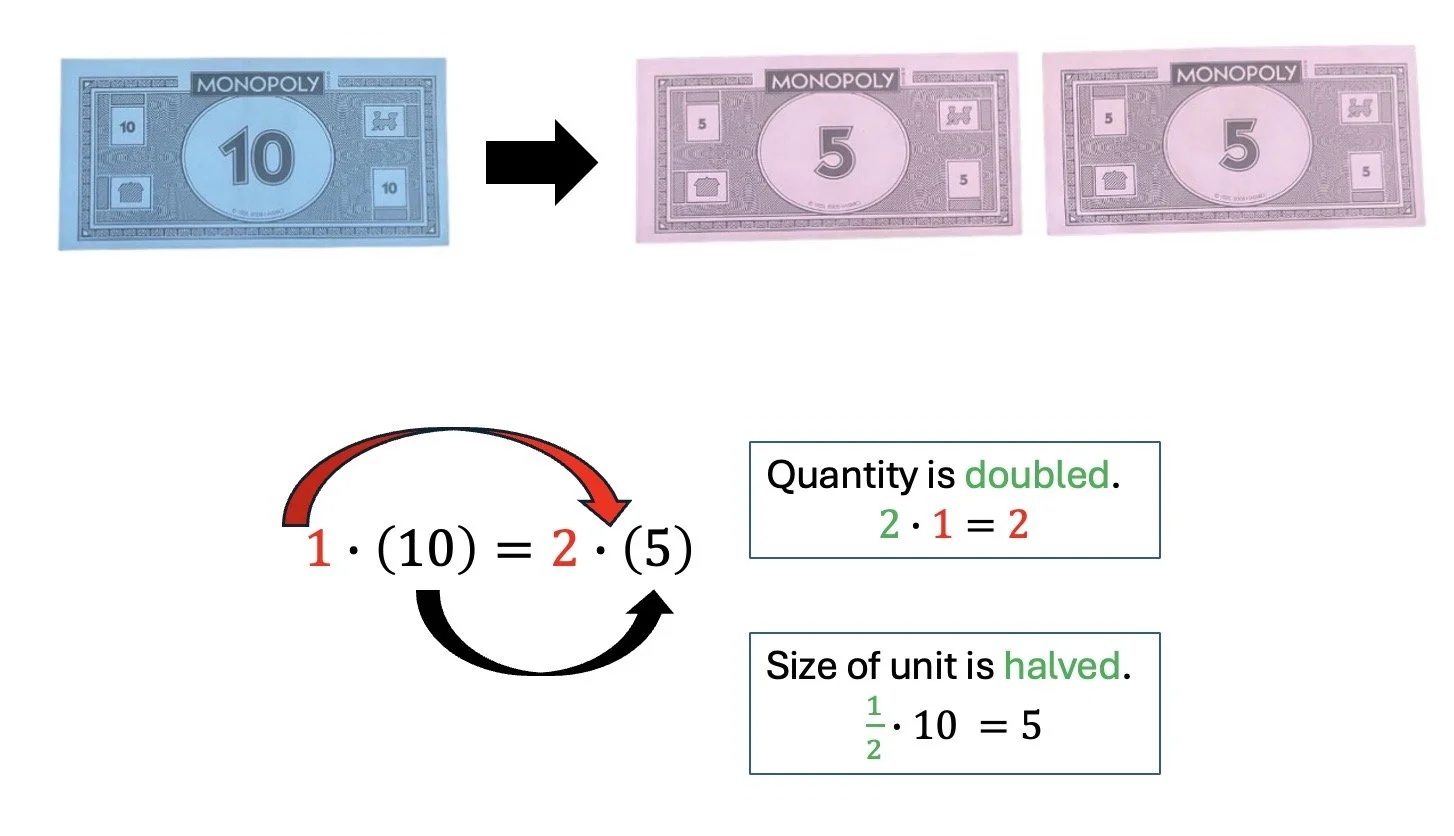
The mathematics of exchanging 1 ten dollar bill for 2 five dollar bills.
From Money to Equivalent Fractions
This relationship can be stated more generally: when the quantity is multiplied by a number n, the size or value of each unit is multiplied by 1/n. The relationship also works in reverse. We can have more units that are smaller or fewer units that are larger while preserving the total amount.
This is exactly what happens with equivalent fractions. Suppose we want to add 1/4 and 3/8. We often tell students to find a common denominator, but that direction can sound like an unexplained rule. What we really need is a common unit. Fourths and eighths are different-sized units, so we rename 1 fourth as 2 eighths. The amount does not change. Just as 1 ten-dollar bill can be exchanged for 2 five-dollar bills, 1 fourth can be exchanged for 2 eighths. In both cases, the number of units doubles while the size of each unit is halved.
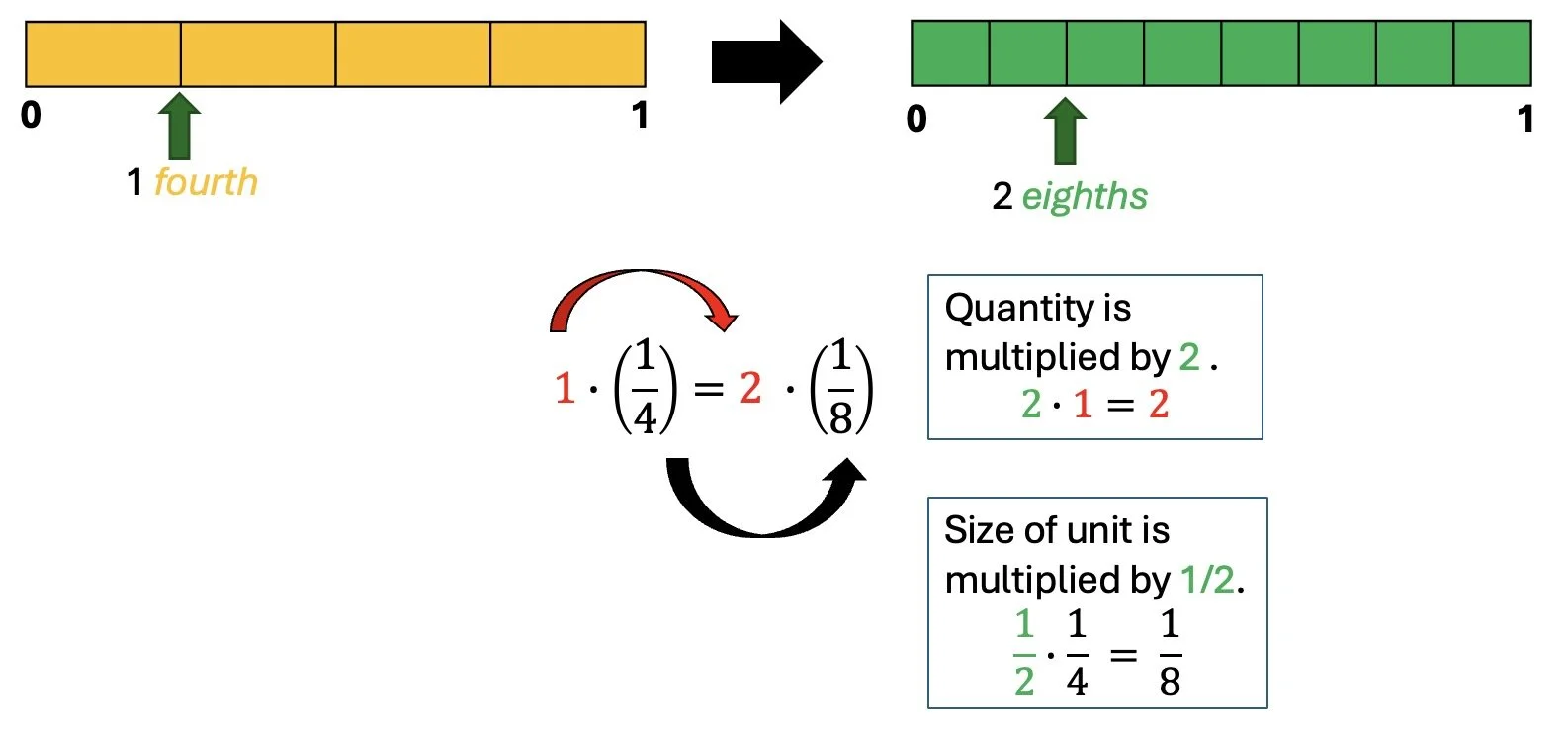
The mathematics of exchanging 1 fourth for 2 eighths. The quantity is doubled and size of unit is halved.
Equal Exchanges in Place Value
Equal exchanges are already built into our base-ten number system. In the examples below, notice how the quantity (bolded) changes as the named unit changes.
100
100
100
100.0
Each expression names the same amount in a different way: 1 hundred, 10 tens, 100 ones, and 1,000 tenths. Each time the number of units is multiplied by 10, the size of the unit is multiplied by 1/10. This is why place-value exchanges preserve the value of a number.
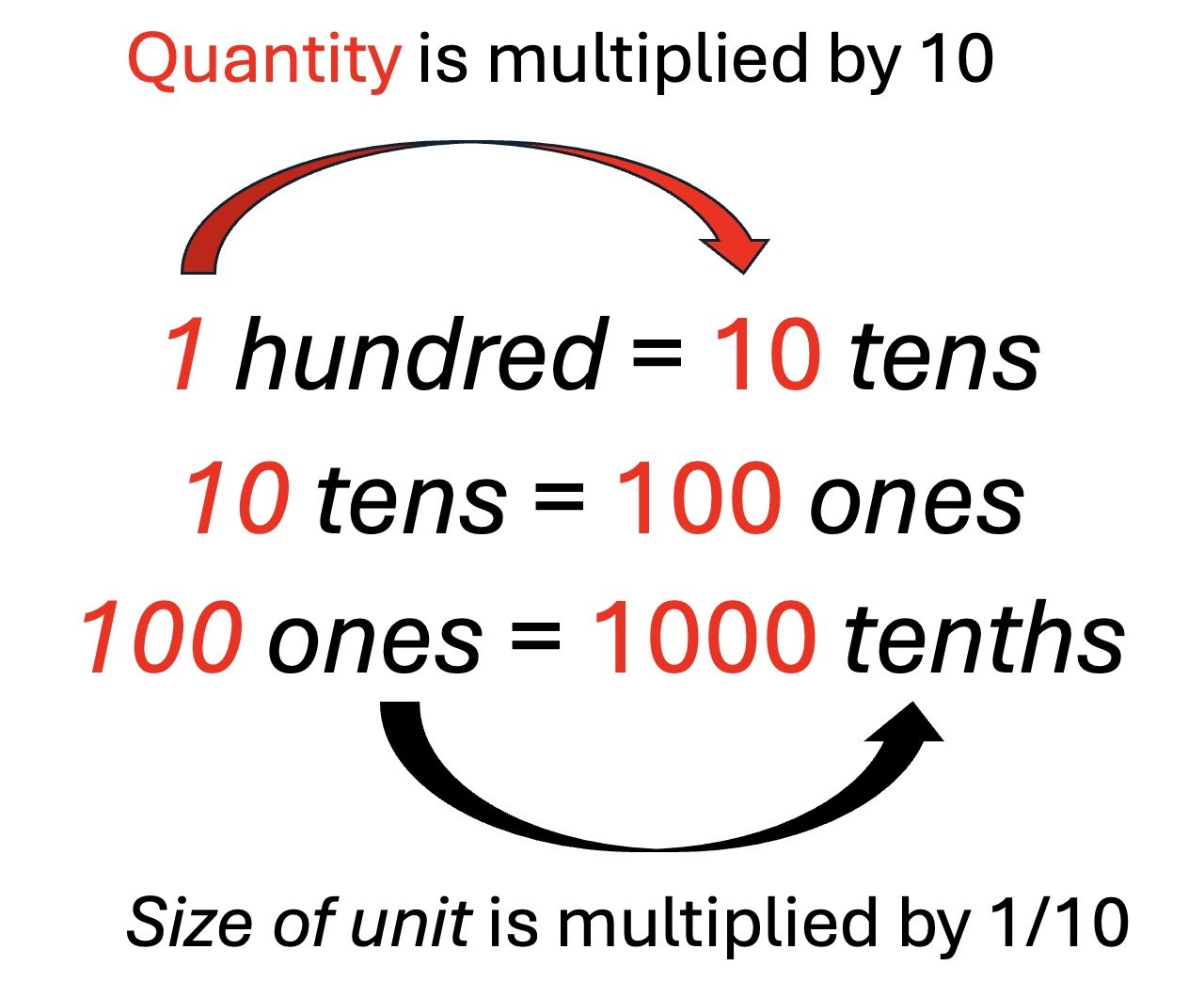
The equal exchanges of the decimal number system. The same set of numerals can represent many different equal exchanges.
Regrouping Is an Equal Exchange
Equal exchanges also explain what happens when we compose and decompose units during addition and subtraction. Consider adding together the numbers 38 and 54. In the ones place, 8 ones and 4 ones make 12 ones. In the traditional algorithm, we write 2 ones and “carry the 1.” That phrase hides the mathematics. We are actually exchanging 10 ones for 1 ten. The number of units is divided by 10 (multiplied by 1/10) while the size of the unit is multiplied by 10. The amount remains unchanged.
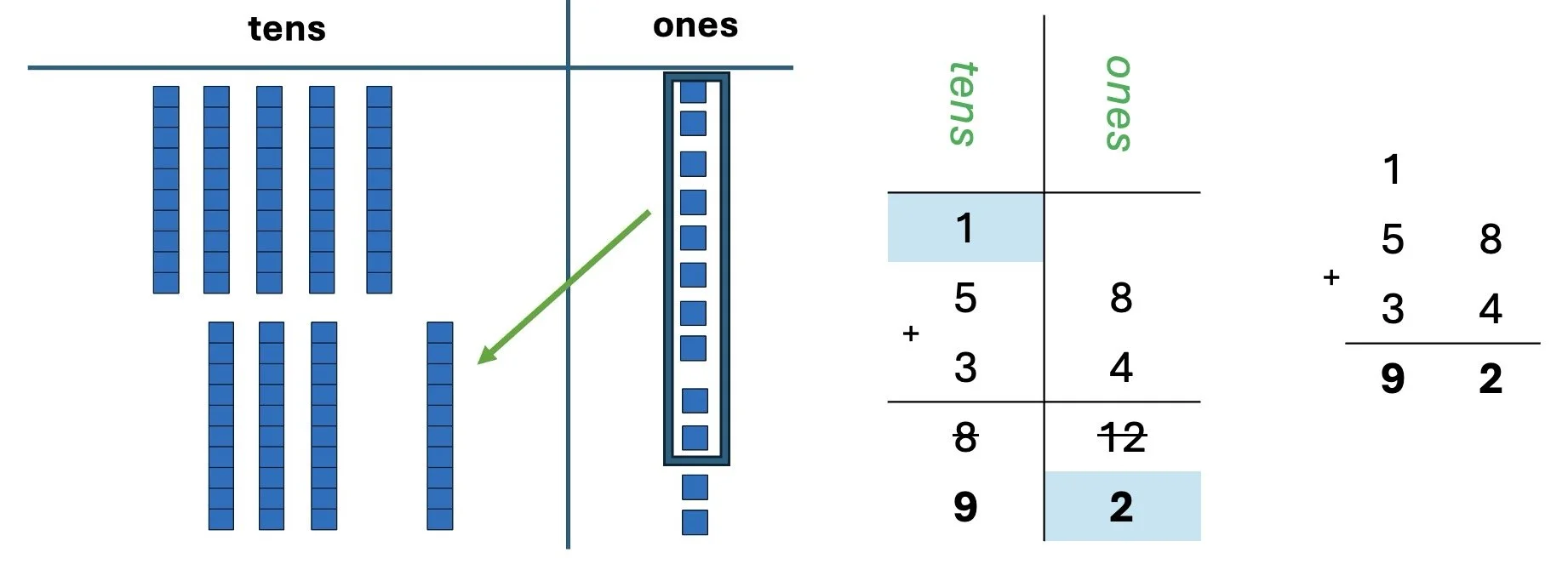
When adding together the numbers 38 and 54 we create an equal exchange of 10 ones for 1 ten.
One Idea Across Mathematics
Equal exchange is the idea that connects regrouping, equivalent fractions, money, and even scientific notation. For example, 360,000 can be described as 360 thousands, 36 ten-thousands, or 3.6 hundred-thousands—scientific notation. Each name represents the same number. As the quantity of units is divided by 10, the size of the unit is multiplied by 10.
When students recognize this relationship, topics that may have seemed unrelated begin to fit together. They can see that regrouping is not merely “carrying,” equivalent fractions are not created by an arbitrary multiply-the-top-and-bottom rule, and place value is more than identifying the position of a digit. In every case, we are renaming the same amount using a different quantity and size of units.
Recommendations for Teachers
Use the language of units. Ask students to name both the quantity and the unit: 3 fourths, 12 ones, or 4 hundreds. This keeps attention on what is being counted.
Replace rules with meaning. Instead of saying only “find a common denominator,” explain that quantities can be combined only after they are expressed using the same-sized unit.
Connect fractions to familiar exchanges. Begin with money or place-value exchanges before moving to equivalent fractions. Ask what changes, what stays the same, and why the exchange is equal.
Use representations that show both relationships. Bar models, number lines, base-ten blocks, and drawings of money can help students see the change in both the number of units and the size of each unit.
Ask students to explain the exchange. Use prompts such as, “How did the number of units change?” “How did the size of the unit change?” and “How do you know the total amount stayed the same?”
Connect ideas across grade levels. Revisit equal exchanges when teaching regrouping, decimals, equivalent fractions, measurement conversions, and scientific notation. Naming the shared idea helps students build a connected understanding of mathematics.
The Lasting Value of Equal Exchanges
Equal exchanges give students a way to reason about mathematics instead of memorizing a separate rule for every topic. The number of units may change, and the size of each unit may change, but the total amount stays the same. Once students understand that relationship, they have a powerful tool for making sense of numbers.
Want to Know More About Equal Exchanges?
If this way of thinking about equal exchanges resonates with you, I explore these ideas more deeply in my professional learning workshops, where teachers examine how representations, language, and symbols can help students build connected mathematical understandings. You can learn more on my Professional Learning page and in my book, See It, Say It, Symbolize It, which offers practical ways to help students see mathematical relationships, describe their thinking, and connect those ideas to meaningful notation.