My grandmother loved a good riddle. “How do you catch a unique rabbit?” she would ask. “U ‘neek up on it!” And how do you catch a tame rabbit? “Tame way!”
That familiar punchline captures the feel of an analogous problem: the situation looks a little different, but the underlying mathematics is familiar. When students learn to recognize that structure, they can use what they understand in one problem to make sense of another.
Try these two addition problems. Before reading on, solve each one and notice what stays the same and what changes.
John rode 58 miles on his bike this month. Lucy rode 34 miles. How many miles did they ride altogether?
John ran 5.8 miles yesterday. Lucy ran 3.4 miles. How many miles did they run altogether?
The models and written recordings below show one way to think about the first problem.
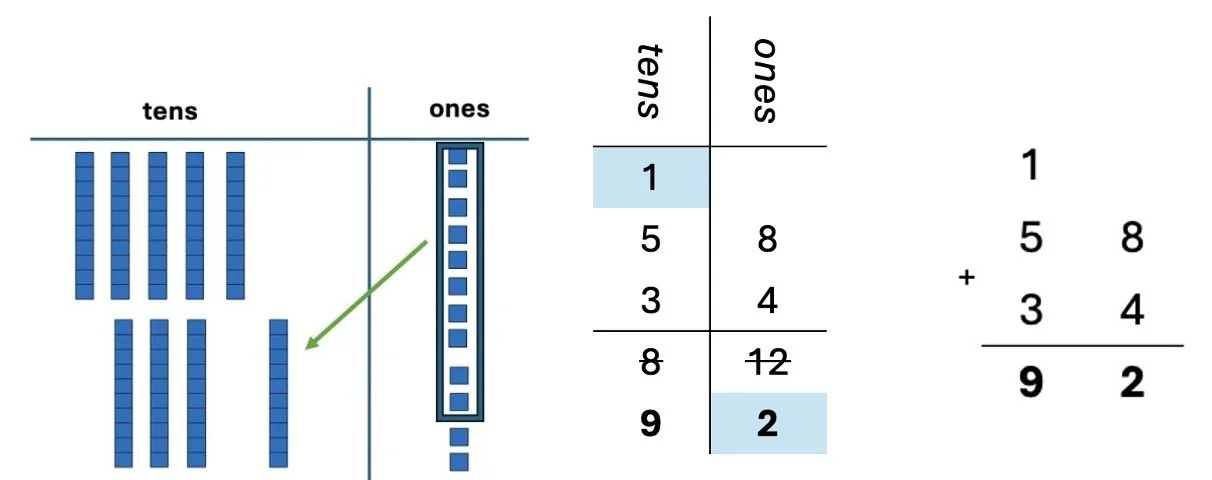
Seeing, Saying, and Symbolizing 58 + 34.
In 58 + 34, 8 ones and 4 ones make 12 ones. We exchange 10 of those ones for 1 ten, leaving 2 ones. Then 5 tens, 3 tens, and the exchanged 1 ten make 9 tens. The total is 9 tens and 2 ones, or 92.
Now look at the second problem through the same lens.
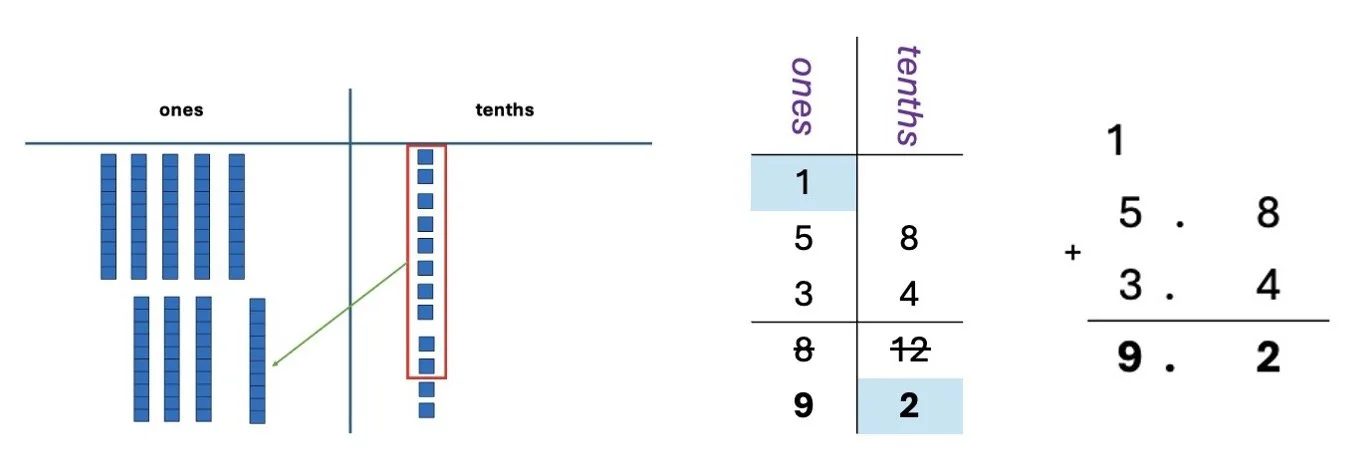
Seeing, Saying, and Symbolizing 5.8 + 3.4.
The numerals (quantities) are the same, the actions are unchanged; only the unit is different. 8 tenths and 4 tenths make 12 tenths. We exchange 10 tenths for 1 one, leaving 2 tenths. Then 5 ones, 3 ones, and the exchanged 1 one make 9 ones. The total is 9 ones and 2 tenths, or 9.2.
These problems are analogous because the quantities and actions on those quantities are the same. In both, we combine like units, make an equal exchange, and combine the larger units. What changes is the size of the unit: tens and ones in the first problem and ones and tenths in the second.
Using the words of my grandmother in the rabbit riddle, “It’s the tame way!” The same relationship appears in 5,800 + 3,400; 580 + 340; 0.58 + 0.34; and 0.058 + 0.034. These tandem problems can help students connect whole-number and decimal operations by attending to the units being counted, rather than treating each as a separate idea. For example, have you ever witnessed having no issue with whole number operations, but struggle with decimal operations involving the same numerals?
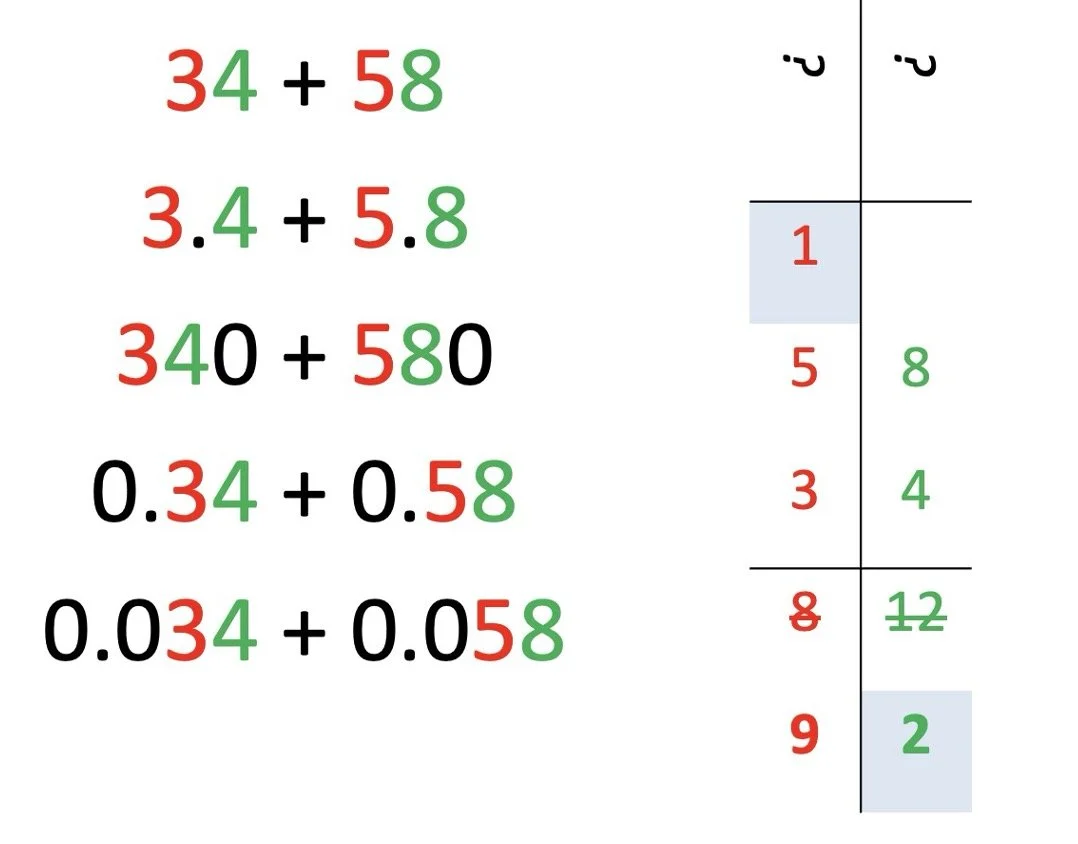
Addition problems that are analogous to 58 + 34.
Addition is only one place to look for these connections. Analogous problems appear across all four operations. Subtraction has the same “feel”. Let’s look at multiplication and division to see something a little different!
Multiplication: same quantities , same actions, different units
Consider 6 × 8. Six groups of 8 ones make 48 ones, which can be regrouped as 4 tens and 8 ones. Now compare 6 × 80. The grouping action is the same, 48 of something different. Six groups of 8 tens make 48 tens, which can be regrouped as 4 hundreds and 8 tens, or 480. The table below shows more related examples. Across the problems, the quantity of groups and the multiplication action stay the same while the unit changes. More analogous problems to 6 x 8 are shown below.
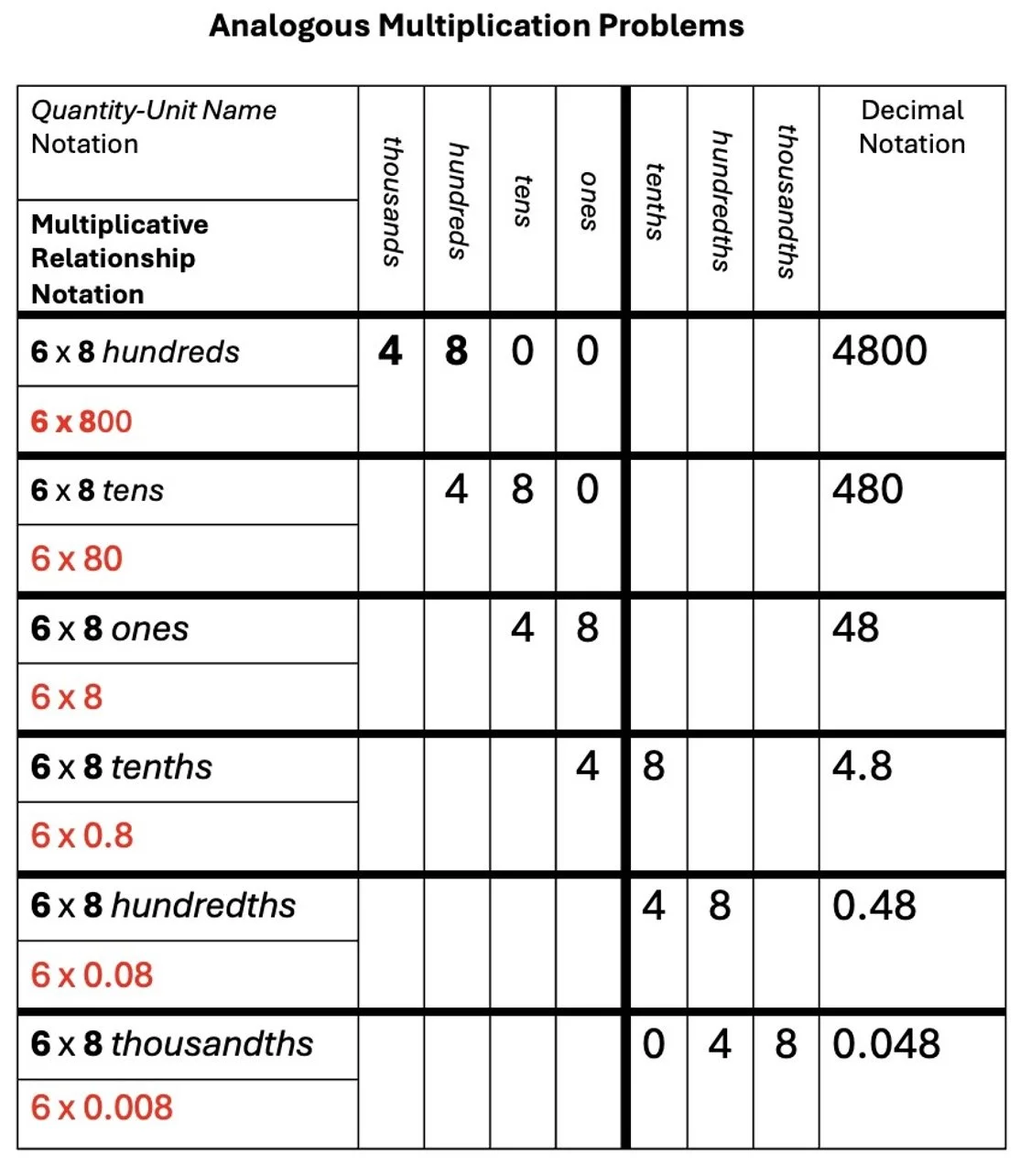
Analogous multiplication problems to 6 × 8.
Division: same quantities, same actions, different units
Read the two situations below. As you do, ask: How many groups can be made, and what is the size of each group?
You have 8 brownies. You want to make bags containing 2/3 of a brownie each. How many bags can you make?
You have 24 brownies. You want to make bags containing 2 brownies each. How many bags can you make?
The student work below represents both situations.
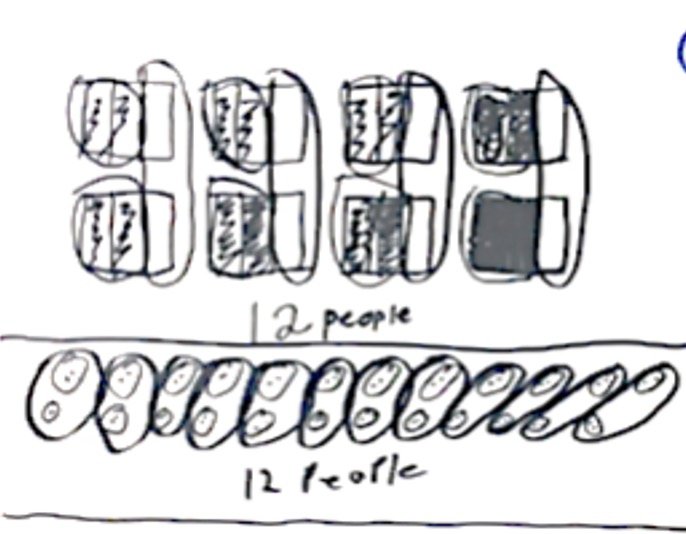
Student work showing the inner workings of analogous problems: Same actions, same quantities, different sizes of units.
For the first problem, the student partitions each of 8 brownies into thirds, creating 24 thirds. The question becomes: How many groups of 2 thirds can be made from 24 thirds? The answer is 12 bags. In the second problem, there are 24 whole brownies and groups of 2 whole brownies, so the answer is also 12 bags. The grouping action and the number of groups are the same. The unit being counted changes from thirds to wholes.
This is the power of analogous problems: they invite students to see relationships among ideas that can otherwise feel disconnected. At first, a teacher may place two problems side by side and ask students to compare them. Over time, students can begin to recognize the structure themselves, create a related problem, and explain why the problems belong together.
Teacher recommendations
• Place tandem problems side by side. Choose pairs that preserve the quantities or actions while changing one feature, such as the size of the unit.
• Ask students to name what stays the same and what changes. Prompt them to identify the units, the action, and what each number counts.
• Connect models, language, and notation. Use tools such as base-ten blocks, unit charts, arrays, or fraction strips, and ask students to explain how each representation matches the written expression.
• Vary the unit deliberately. Include whole numbers, decimals, and fractions so students can trace a familiar action across different-sized units.
• Invite students to make their own analogous problems. Ask them to explain the relationship, not just produce a problem with similar-looking numbers.
• Listen for unit-based reasoning. When students explain an exchange or a grouping, ask what unit is being counted and why the exchange preserves the quantity.
When students can see a mathematical relationship, say what makes it hold, and symbolize that reasoning, they can carry understanding from one problem to the next. Want to learn more about the power of analogous problems? Check out my book connections in See It, Say It, Symbolize It. Do you need a copy of the analogous multiplication chart to share with your class?
Visit Unleashing Mathematical Brilliance to learn more about my work, professional learning, and resources for helping students make sense of mathematics.