How Are Fractions Like a Chameleon?
Unleashing Students’ Fractional Reasoning Brilliance
Fractions can represent measures, ratios, division, operators, and part-whole relationships. When students encounter these changing meanings without a connected understanding of quantities and units, fraction rules can feel arbitrary and confusing.
In this interactive professional learning experience, teachers examine student thinking, participate in classroom-ready activities, and learn how a fraction-as-measure approach can help students understand equivalence, comparison, and fraction operations.
Why Are Fractions So Difficult to Teach?
Students often learn fractions as “pieces of a whole.” Although this interpretation can provide a useful starting point, it does not adequately prepare students to think about fractions as numbers, compare their sizes, explain equivalence, or make sense of operations.
Teachers also encounter students who produce correct answers using fragile reasoning. This workshop helps teachers recognize such reasoning and respond in ways that develop a more connected understanding of fractions.
A glimpse into student thinking
Student: 7/8 and 5/6 are equal.”
Teacher: “Why do you think so?”
Student: “They both need one more piece to make a whole.”
The response reveals reasoning that a correct-or-incorrect score alone cannot capture.
What do students see when they look at a fraction?
What Participants Will Explore
Student Thinking
Examine student responses to uncover how students interpret fractions and why seemingly reasonable strategies can lead them astray.
Meaningful Representations
Use lengths, bars, and number lines to support partitioning, iterating activities while comparing fractions.
Fractions as Measures
Help students see fractions as numbers composed of quantities and sizes of units.
Connected Fraction Operations
Make sense of fraction operations through quantities, units, and equal exchanges rather than disconnected rules.
An Interactive Workshop Experience
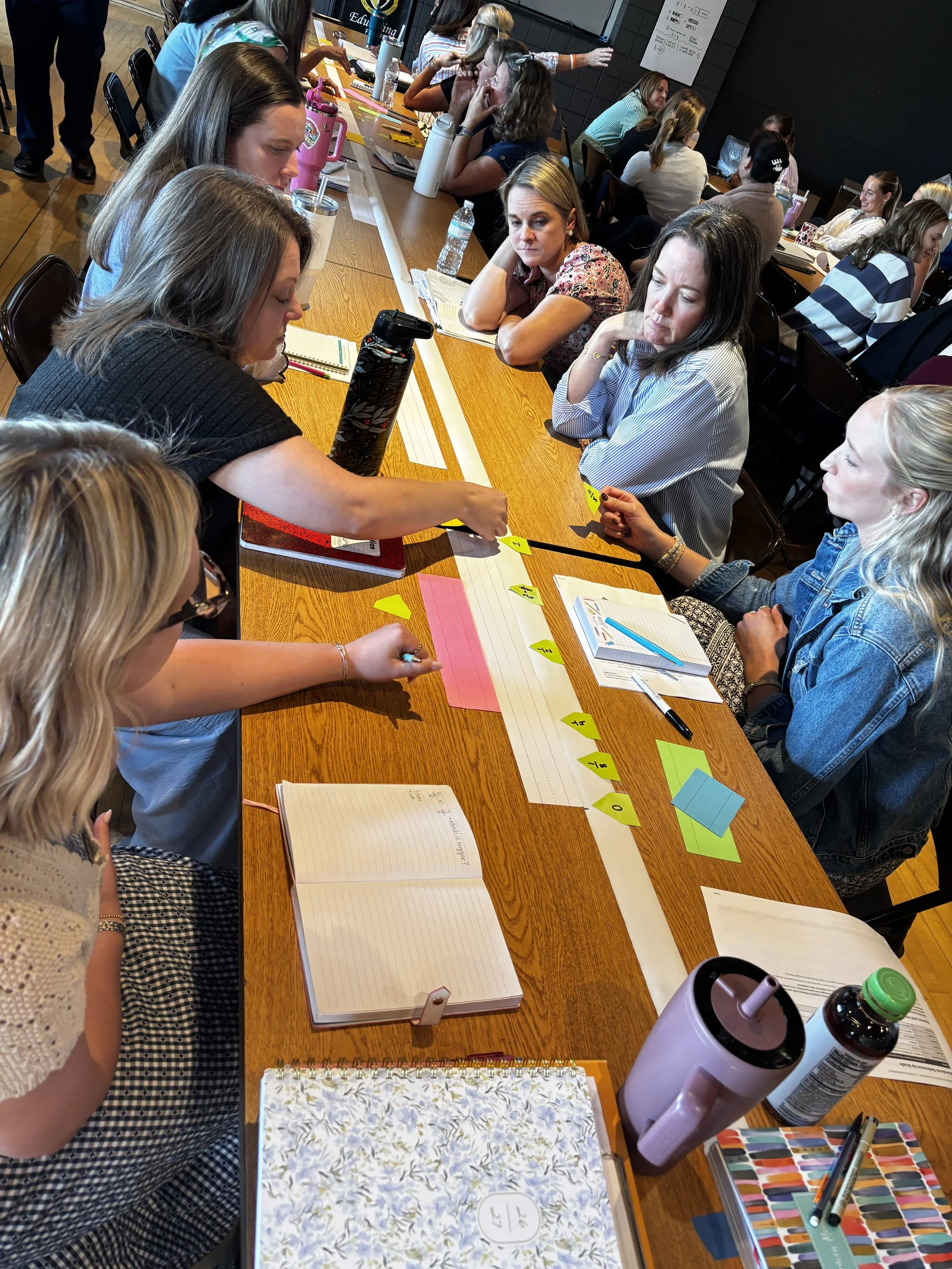
Teachers using fraction strips and length models during an interactive mathematics professional learning workshop.
Participants do mathematics, examine student thinking, and discuss how instructional choices influence what students understand about fractions.
Solve carefully selected fraction tasks and compare different reasoning strategies.
Analyze student responses, including correct answers supported by incomplete reasoning.
Use fraction strips, length models, and number lines to partition and iterate units.
Describe fractions using multiplicative unit language such as “three groups of one fourth” and “six groups of one eighth”.
Connect equal exchanges to equivalence, comparison, and fraction operations.
Consider how curriculum materials support or interfere with fraction-as-measure reasoning.
What Teachers Take Back to The Classroom
Participants leave with a clearer understanding of fractional reasoning and practical tools they can use with students immediately.
A Diagnostic Lens
Recognize what students’ answers reveal about their underlying fraction conceptions.
Purposeful Questions
Use questions that help students attend to quantities, unit sizes, and mathematical relationships.
Classroom-Ready Tasks
Adapt comparison, equivalence, number-line, and operation tasks for immediate classroom use.
Curriculum Analysis Tools
Evaluate whether instructional materials develop fraction-as-measure reasoning or reinforce disconnected procedures.
Designed for Your Teachers and Their Students
The workshop can be adapted to match your teachers’ grade levels, current curriculum, and professional learning priorities.
Who It Is For
Elementary and middle school teachers
Mathematics interventionists
Instructional coaches and specialists
Curriculum coordinators and school leaders
Preservice and in-service teacher educators
Flexible Formats
Conference or district workshop
Half-day professional learning
Full-day interactive experience
Multi-session professional learning series
Customized support focused on local curriculum and student needs.
Patrick will work with your school or district to select the format and emphasis that best support your teachers.
“This was one of the best sessions I’ve been to in my 28-year teaching career. Patrick calmed my math anxiety and presented information in a conceptual way.”
—Workshop Participant
““This is the best professional development we have had in years. Patrick is incredibly knowledgeable, and I can actually use what I learned in my classroom.”
—Workshop Participant
Meet Your Facilitator

Dr. Patrick Sullivan is a Professor of Mathematics at Missouri State University, an experienced mathematics educator, and the author of See It, Say It, Symbolize It. He has worked with teachers and school leaders across the country to strengthen mathematics teaching through meaningful representations, precise language, and attention to student thinking.
A former mathematics department chair and school principal, Patrick brings both classroom experience and research-based insight to professional learning. His interactive workshops help teachers understand the mathematics they teach more deeply and translate that understanding into practical instructional decisions.
Presidential Awardee for Excellence in Science and Mathematics Teaching recipient • Mathematics teacher educator
Help Your Teachers Make Fractions Make Sense
Bring this interactive professional learning experience to your school, district, conference, or organization. Patrick will work with you to tailor the workshop to your teachers, curriculum, and professional learning goals.
Half-day, full-day, conference, and multi-session formats are available.