In Hidden Figures, Dorothy Vaughan sees that new technology is changing the work around her. She recognizes that she and the women on her team will need new skills to keep contributing, so she teaches herself to program and helps her colleagues prepare for what comes next.
Mathematics teachers face a similar challenge. Technology can now calculate quickly and accurately, but many of us learned to teach in a time when efficient paper-and-pencil computation was treated as a central goal. We may believe students need richer mathematical experiences, yet changing our teaching is hard—especially when we have limited time, few opportunities to see new approaches modeled, and assessments that still reward getting the answer quickly.
We often teach the way we were taught. If our own mathematics classrooms emphasized procedures and answers, it can be difficult to imagine a different kind of classroom—one where students explain, question, estimate, and make sense of why a method works.
So what needs to change? Computation still matters. But students also need to reason about quantities, judge whether an answer makes sense, and decide how to use technology thoughtfully. That shift asks us to retool our teaching. To begin, let’s consider what I mean by a “1970s mindset.”
What do I mean by a “1970s mindset”?
In Mathematical Mindsets, Jo Boaler presents a comparison of skills Fortune 500 companies reportedly valued in 1970 and 1999. In that comparison, computational skills rank second in 1970 and twelfth in 1999. Problem solving moves from twelfth in 1970 to second in 1999, while teamwork ranks first in 1999 (Boaler, 2015, p. 28).
This comparison is an illustration of changing priorities over time, not a current survey of employers. It also does not show that computation stopped mattering. Instead, it invites us to think about how the role of computation has changed as technology has made calculations faster and more accessible.
Consider the problem 2/3 x 9/10 A calculator can quickly return 0.6. But students need more than the answer. They need to understand why 0.6, or 6/10 is reasonable—and how the quantities in the problem relate to one another.
Procedures such as “multiply straight across” and “keep, change, flip” can help students get answers. But when students learn only the steps, they may not understand the mathematical ideas that make those steps work. There is a place for efficient procedures, particularly as students encounter more complex expressions and problems. The concern is when a procedure becomes a substitute for making sense of the mathematics.
Answers are easy to get. Reasoning still takes work.
Technology changes what students can do quickly. It also makes it more important for them to decide whether a result is reasonable. If students know only how to enter an expression, they may not notice when they have entered it incorrectly or when the result conflicts with the situation.
For 2/3 x 9/10 students can reason that the answer must be less than 9/10: taking two-thirds of a quantity gives us less than the whole quantity. They can also connect this problem to finding the answer 2/3 x 9.
In both cases, the amount is divided into three equal groups, and two of those groups are selected. When the amount is 9, each group has 3, so two groups total 6. When the amount is 9 tenths, each group has 3 tenths, so two groups total 6 tenths. The quantities differ, but the action is similar.
Students can also consider more than one way to find the answer. They might first divide 9 tenths into three equal groups and then take two groups. Or they might find two-thirds of 9 tenths by multiplying by 2 and then dividing by 3. One approach may feel more efficient or make the quantities easier to work with. Understanding includes knowing why a strategy works and recognizing when a strategy is useful.
For example, a student can use the multiplication procedure to find that 2/3 of 5/7 is 10/21. But is getting 10/21 all we want the student to know? We also want the student to understand what it means to take two-thirds of a quantity, make sense of the result, and explain how the chosen strategy connects to the quantities in the problem.
The value is in understanding what the symbols mean.
Consider another example: expressions such as 8/2(2+2) often appear online as “break the internet” puzzles. The disagreement over how to evaluate them can be entertaining, but the deeper mathematical value lies in understanding how notation communicates the order of operations.
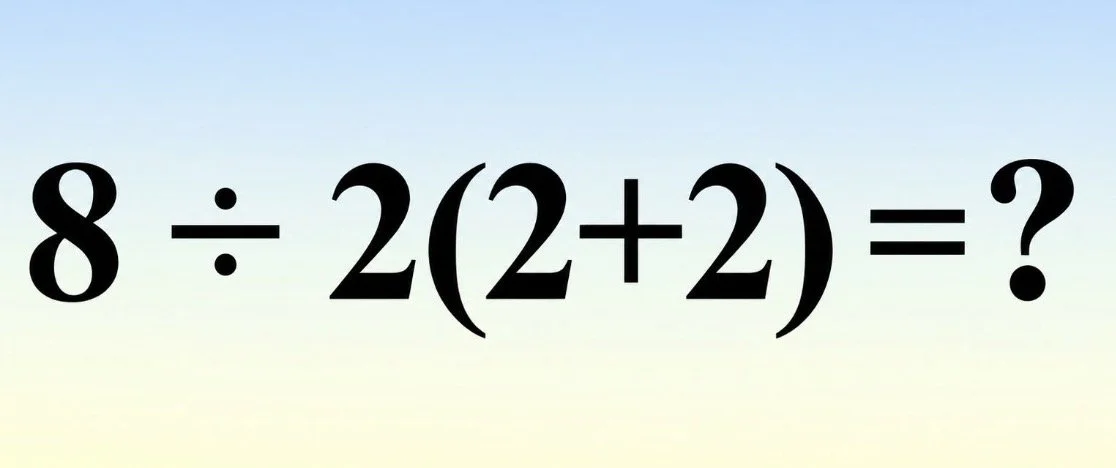
An example of a problem that allegedly “broke the internet”!
That understanding matters when we enter formulas into a spreadsheet. If a numerical value is stored in cell A2, the formulas =4*A2+2 and =4*(A2+2) produce different results. In the first formula, the spreadsheet multiplies the value in A2 by 4 and then adds 2. In the second, it adds 2 to the value in A2 before multiplying by 4. Parentheses tell the spreadsheet—and the reader—how the expression is grouped.
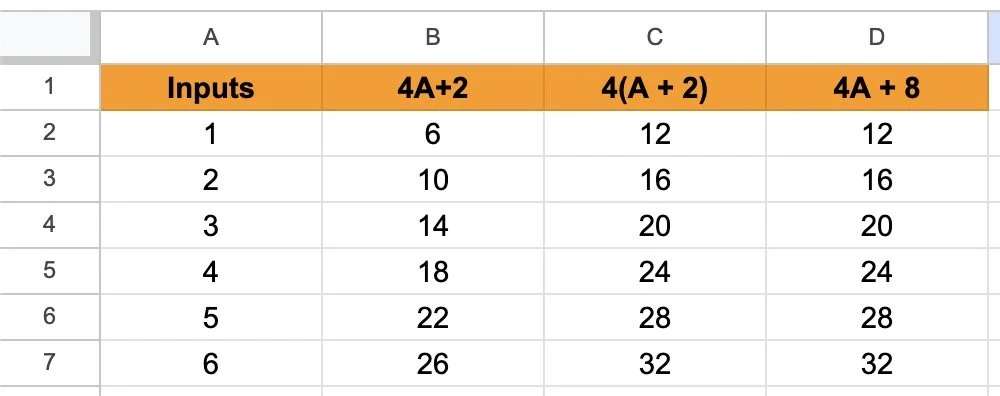
Different outputs for the same input. Which expressions are equivalent?
We can use spreadsheets to calculate monthly payments, compare options, or explore other situations involving complex formulas. Students may not need to perform every calculation by hand, but they do need to understand what the formula represents, how its parts work together, and whether the result makes sense.
What might we need to retool?
A powerful thought experiment is to look at our own curriculum and ask: Where might students be learning to follow steps without understanding the relationships those steps represent? Where are they expected to produce an answer without explaining or checking it?
Once we identify those places, we can consider how to make room for students to estimate, represent their thinking, compare strategies, ask questions, and explain why a result is reasonable. The goal is not to remove computation. It is to help students connect computation to meaning and use it as one part of mathematical reasoning.
Like Dorothy Vaughan and her colleagues, teachers need time, support, and opportunities to learn new ways of working. Retooling is difficult when we are expected to make changes without seeing them modeled or having the resources to try them. But we can begin by examining one lesson, one procedure, or one familiar problem and asking what we want students to understand beyond the answer.
Technology can calculate. Our students still need to decide what to calculate, how to interpret the result, and whether it makes sense. What parts of your curriculum might still be preparing students for a world in which the calculation was the work—and what could you change to make the reasoning visible?
Questions for teachers to consider
If students can use technology to calculate, what should they still learn to do themselves? A few questions can help us examine whether our instruction is building the mathematical reasoning students need:
What do I want students to understand beyond the answer? Identify the quantities, relationships, or mathematical ideas behind the procedure.
When does calculating by hand support understanding? Keep opportunities for computation that build number sense and help students see why a method works.
How will students decide whether an answer is reasonable? Ask them to estimate, compare the result with the original quantities, or explain what the answer means in context.
Are students learning to choose and explain strategies? Give them chances to compare methods and discuss which is useful for a particular problem and why.
How will students use technology thoughtfully? Have them consider what to enter, interpret the output, and check whether the result fits the problem.
What does my assessment value? Make room for explanations, representations, and reasoning alongside correct answers.
Is your school interested in learning more about how to make “one change” to improve student learning? Check out professional learning opportunities!